The Most Bizarre Kidnapping Plot in Border History Led a Cop-Killer Through the Heart of Texas
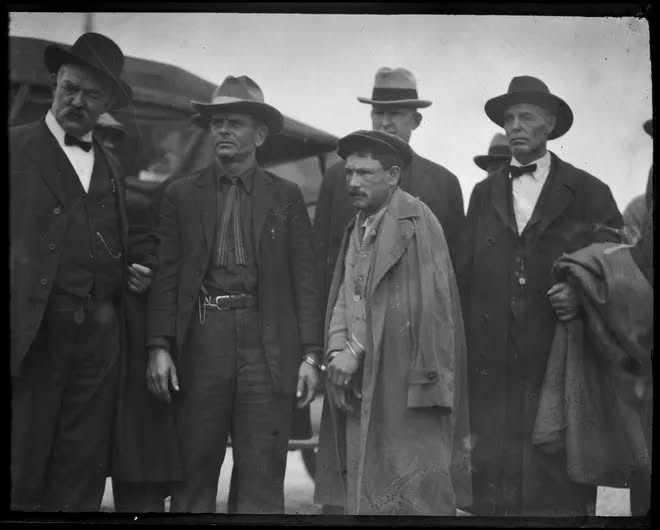 The sleeper car rocked gently as it rolled through the dark Texas landscape on February 10, 1923, carrying one of the most wanted criminals of its time. Inside, shackled to his bunk and heavily guarded, sat Felipe “Arizona Phil” Alguin—a pint-sized killer whose journey through San Antonio would become a pivotal chapter in one of the era’s most sensational manhunts.
The five-foot-nothing gangster had finally been captured after a cat-and-mouse game that spanned two countries, involved international diplomacy, and nearly sparked a lynching in Juárez. Now, as the train approached San Antonio in the dead of night, Los Angeles Police Chief Louis D. Oaks sat nearby, exhausted but vigilant, his six-thousand-mile pursuit finally nearing its end.
The Making of a Killer
Benito Baca was born in Arizona, a place that would forever mark him—literally. The tattoo on his lower right arm reading “Arizona Phil” superimposed over a flower would become his signature, his curse, and ultimately, his downfall. By the time he reached Los Angeles, he’d adopted the name Felipe Alguin and had already earned the moniker “Little Phil” for his diminutive stature and oversized criminal ambitions.
His rap sheet read like a criminal’s greatest hits: bootlegger, gambler, narcotics pusher, and three-time loser for armed robbery. But on the humid night of June 18, 1921, Little Phil crossed a line from which there was no return.
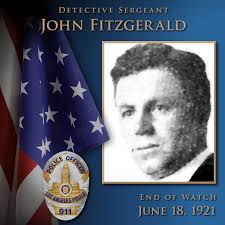 Detective Sergeant John J. Fitzgerald opened the door of a suspected hideout, and Little Phil answered with gunfire. The detective, whose testimony had put Alguin behind bars on his last conviction, died forty minutes later.
What happened next demonstrated the cold-blooded calculation that made Alguin so dangerous. Commandeering a streetcar for his escape, he spotted an innocent bystander and shot him—not for money, not in self-defense, but simply to steal the dying man’s hat. “It would make him too conspicuous,” he later explained with chilling nonchalance, “to be seen running around without a hat”.
The Relentless Pursuit
Chief Oaks took the murder personally. Fitzgerald had been a close friend, and Oaks threw himself into the manhunt with obsessive determination. Over the following months, he would travel more than nine thousand miles and spend over six thousand dollars of police funds chasing leads across the American landscape.
The trail twisted through South Dakota, where Alguin joined the Bailey & Hudson Circus, working as a clown until his “Latin temper” got him into a fight and forced him to move on. It wound through Baltimore and Chicago as the killer stayed one step ahead of the law.
Then the trail went cold. Little Phil had vanished south of the border.
The Haven Across the Rio Grande
In Juárez, Mexico, Felipe Alguin found sanctuary—and hubris. Living openly with a chorus girl, he brazenly crossed into El Paso multiple times, “sneering at the five thousand dollar reward posted by the City of Los Angeles and the fact that his picture was plastered prominently on every police bulletin board”.
The timing couldn’t have been better for a fugitive. Relations between Mexico and the United States had deteriorated to their lowest point in years. The landing of Marines at Vera Cruz still rankled. General John J. Pershing’s invasion hunting for Pancho Villa remained a fresh wound. And Washington’s refusal to recognize the current Mexican government meant there could be “no asking to extradite the pint-sized bandido”.
In this poisoned atmosphere, Alguin became untouchable—or so he thought.
His fatal mistake came on September 15, 1922. Three masked men robbed William L. Benton, paymaster for a brick company near El Paso, making off with over fourteen hundred dollars before racing across the border.
When Juárez police rounded up suspects, Alguin was among those questioned and released. But this time, he’d left behind evidence he couldn’t talk his way around: fingerprints on Benton’s car that matched those of the cop-killer.
The call went out to Chief Oaks. His quarry was finally identified—and completely beyond his reach.
The Kidnapping Scheme
What happened next reads like pulp fiction, yet every word is documented history. In a desperate council of war at El Paso police headquarters, an audacious plan took shape—and its architect was one of the most decorated heroes of World War I.
Sam Dreben, known to newspaper readers across America as “The Fighting Jew,” had earned his legend as a soldier of fortune in Mexico and later as first sergeant in Major Richard F. Burges’s El Paso company during the Great War. General John J. Pershing himself called him “the bravest man and one of the finest soldiers he had ever known”.
Now Dreben proposed something that sounded insane: they would kidnap Little Phil.
The scheme exploited Alguin’s one vanity—his desperation to remove that tell-tale “Arizona Phil” tattoo. “It was a dead giveaway,” Dreben explained, “since the description was on the ‘wanted flyer’ posted in every major American police station”.
They would plant a “doctor” in Juárez, a plastic surgeon who specialized in tattoo removal. When Alguin took the bait and went under anesthetic, they’d carry him across the Santa Fe Street bridge to El Paso, disguised as a drunk being helped home by his drinking buddies.
“It was a long chance, a wild scheme,” the chronicler noted, “but one worth trying”.
San Antonio Detective J.H. Kelly, who’d served with Dreben in Mexico but was unknown on the border, was recruited to play the surgeon. El Paso physician Dr. R.H. Ellis gave Kelly a crash course in medical theatrics, providing anesthetic, hypodermic needles, and a framed diploma to hang in the waiting room.
The Plot Unravels
The trap was set. Alguin walked right into it.
On the appointed afternoon, “Doctor” Kelly arrived at 110 Second Liberty Street in Juárez, just two blocks from the city jail. In a car down the street sat Dreben, El Paso Detective Chief Claud Smith, Chief Oaks, and their chauffeur C.C. Harvey. A second car loaded with backup waited further down.
The script called for Kelly to signal when Alguin was safely unconscious by spitting out the window. But nothing went according to plan.
First came Alguin’s girlfriend, insisting on staying for the operation. Kelly had to drug her with “a powerful mickey, enough to take care of a horse,” before he could proceed.
Then the anesthetic failed to work properly. Alguin’s subconscious fought the chloroform, leaving him groggy but aware. Kelly was afraid a stronger dose “would be lethal. They wanted Little Phil alive”.
When Dreben entered and saw the situation, he made a fateful decision: “All right. We’ll take him anyway”.
They hustled the half-dressed gangster toward the waiting car. For a moment, success seemed within grasp. Then the fresh air revived Alguin, and he began to scream: “The gringos were kidnapping him and wanted to kill him!”.
What followed was chaos. A crowd materialized as if summoned by magic, rushing to the aid of their neighborhood celebrity. The Americans fought desperately to hold onto their prize, but “it was like trying to hold a wildcat by the tail,” Dreben later recalled.
They managed to get Alguin into the car, and their chauffeur Harvey gunned for the bridge. But someone had telephoned ahead. At the international crossing, guards blocked their path.
The mob surrounded them. Dreben, Smith, and Harvey were overpowered and arrested. Chief Oaks, bleeding and with his shirt hanging in shreds, fought his way through the crowd to the American side. “Doctor” Kelly also escaped.
The March to Death
The three-block march to the Juárez jail became a gauntlet of hatred. The crowd pounded, grabbed, threatened, and spit on the prisoners. Ropes appeared, carried openly as the procession took on “something of the color of the entry of the bull into the ring of the nearby Plaza del Taros”.
Inside the jail, Detective Chief Smith recognized some men he’d previously arrested in El Paso. They huddled and pointed at him. He was placed in solitary confinement to await execution.
Juárez newspapers fanned the flames with inflammatory editorials, reminding readers of American affronts to Mexican pride and promising swift justice. “The press assured swift dealing with the kidnappers, insisting they would be executed within a week”.
General Juan J. Mendez—the same garrison commander Dreben had rescued just a day earlier from an attempted coup—rushed every available soldier to the jail with fixed bayonets. Only military intervention prevented the lynching.
Back in El Paso, the U.S. Army sealed the border. Mayor Charlie Davis, the governor of Texas, senators, and congressmen all appealed to Washington for intervention.
Secretary of State Charles Evans Hughes delivered a cold response: there could be “no representations of any kind from the State Department since the United States did not recognize the existing Mexican government”.
The three Americans were on their own.
The Judge Who Saved Three Lives
Their salvation came from an unlikely source: Juárez Judge Felipe Rodriguez, “a reasonable and courageous man” whose son would later become an El Paso district judge and whose grandson would serve as county attorney.
In an act of extraordinary courage, Rodriguez agreed to reduce the charges to a misdemeanor and accept bond—one thousand dollars each for Dreben and Smith, five hundred for Harvey. His son would later remember “the tension and the 24-hour guard posted at the home for weeks after” his father authorized the men’s release.
General John L. Hines, Army Chief of Staff, happened to be passing through El Paso on an inspection trip when he saw the headlines. He dropped off the train immediately.
“My God!” he exploded. “We can’t let them shoot Sam Dreben! He is the bravest man the Jewish race has produced since the time of Joshua!”.
With a heavy guard thrown around them, the three men crossed the bridge to freedom, met by cheering crowds and clamoring newsmen. When asked to describe his jail experience, Dreben drawled in his thick Russian accent: “Well, the first day wasn’t so bad. You see, it was Yorn Kippur and I would have fasted anyway.” Sam had survived his own Yom Kippur war.
The Government Intervenes
Little Phil Alguin, now a local hero in Juárez, swaggered before reporters. He pointed to “fourteen head wounds” received during the kidnapping attempt and boasted: “I’m just too smart for these hick cops. I’ve beaten them twice and I can do it again. Of course I croaked Fitzgerald. He was a rotten detective anyhow. He doubled-crossed me for a lousy couple of dollars and he got what was coming to him”.
But his days of freedom were numbered. The Mexican government, seeking to extend “an olive branch to its northern neighbor,” began mobilizing against him. The gesture would help bring about U.S. recognition of the Obregón administration in 1923.
As an American citizen, Alguin “had no legal claim to protection from Mexico City,” officials decided. He would be deported.
The mechanism for his removal involved a prisoner exchange. According to the most credible account, Florencio de la Vega, sitting in an El Paso jail on charges of murdering a relative of General Plutarco Elías Calles at Agua Prieta, would be the price for getting Alguin into American hands. On January 17, 1923, de la Vega was suddenly taken from his cell, escorted to the middle of the bridge, and surrendered to Mexican immigration officials. “He was never heard from again”.
The Journey Through Texas
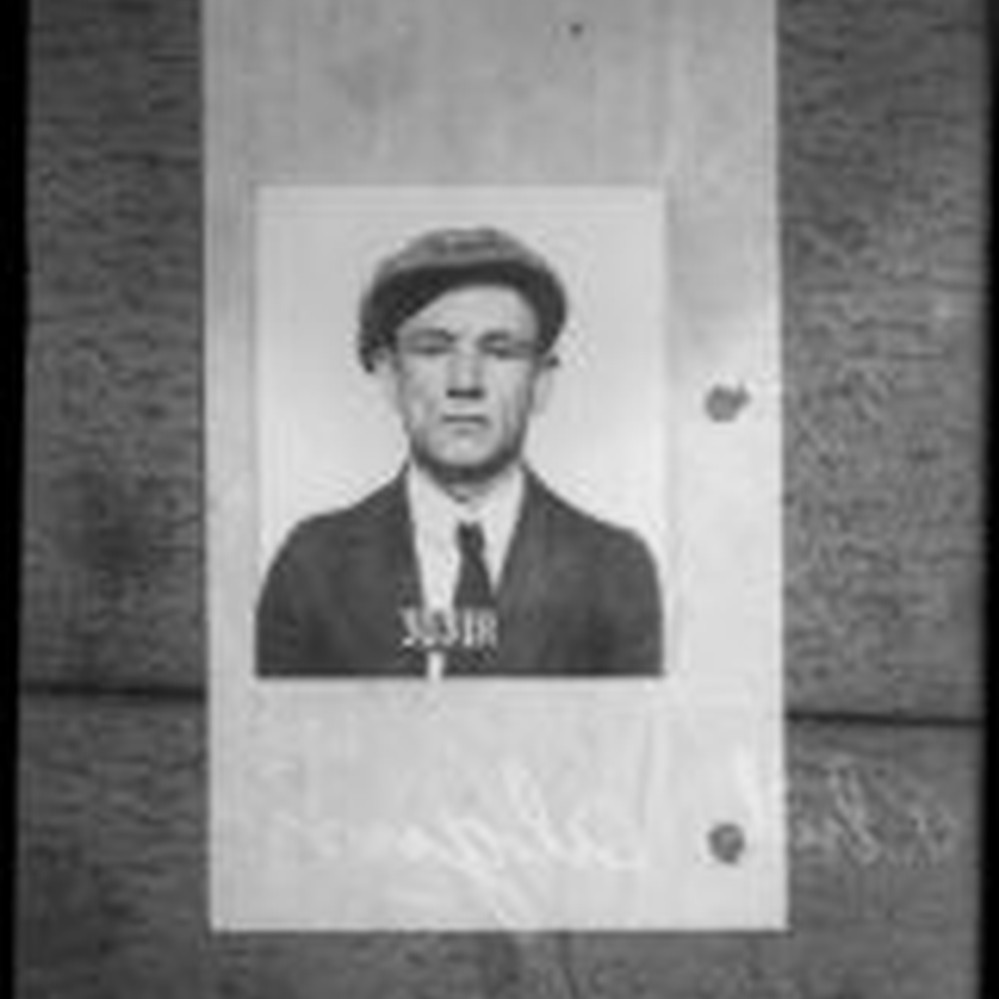
Alguin boarded what he believed was the “Freeport Sulphur,” a tanker sailing from Vera Cruz to Guatemala. The ship’s name was actually the “Tampico,” and its destination was not Central America but Galveston, Texas.
Chained to a bunk and guarded by Lee Manning, a U.S. immigration inspector on “leave of absence from the service to avoid embarrassing it,” Alguin gradually realized he’d been duped.
“This smells like the United States,” he told Manning as the tanker approached port, “and I haven’t a cold in my head either”.
When hauled on deck at Galveston, he broke into “eloquently bilingual cursing,” but quickly recovered his sardonic humor. Chief Oaks had assembled an armed guard so elaborate that Alguin “smirked at the elaborate plans to assure his return, even if Alguin’s gang should blow up the train in a rescue effort”.
The chief’s paranoia was justified. Anonymous death threats had already arrived: “You think you are one brave guy to tote a poor bird back to Los Angeles to his framed-up death. But, oh boy, when we cash in five of your dirty cur dogs, called by the papers ‘police,’ it will be different… You just started something for yourself old kid”.
The delays and detours through Texas were deliberate. Oaks orchestrated overnight stops in Houston and El Paso jails as part of a security plan designed to prevent any rescue attempts by Alguin’s gang.
And so Little Phil passed through San Antonio in the dark hours of late January or early February 1923, one more waypoint in a carefully choreographed journey. The notorious cop-killer spent a night in the city’s jail, another precaution in Chief Oaks’s elaborate security ballet.
In El Paso, Detective Chief Claud Smith—who’d been rewarded for his role in the kidnapping fiasco with the position of chief of the Venice, California, police department—joined the escort for the final leg.
The Confession
As the train rolled through Arizona, the land of his birth and the source of his infamous tattoo, something broke in Felipe Alguin. Perhaps it was the landscape triggering memories. Perhaps it was exhaustion. Perhaps, after nearly two years of running, he simply wanted someone to know the truth.
He turned to Chief Oaks, the man who’d never stopped hunting him.
“You’ve been mighty decent to me,” Little Phil said quietly. “I’ll tell you—I killed Fitzgerald”.
It was the confession Oaks had traveled nine thousand miles to hear.
Justice, California Style
On April 30, 1923, Felipe “Arizona Phil” Alguin stood trial in Los Angeles Superior Court for the murder of Detective Sergeant John J. Fitzgerald. He was “quickly convicted and given a life sentence”.
Six months later, demonstrating the same reckless courage—or stupidity—that had marked his criminal career, he attempted to escape from Folsom Prison by “slipping into a trolley bucket, a hundred feet above ground, in an effort to cross the American River.” He and his companion were caught and returned.
Hauled into court for the “hat slaying” of Frank Rudeen, the innocent bystander he’d murdered simply to avoid appearing conspicuous, a mistrial resulted. Tried again in 1936, he received a second life sentence.
Little Phil would spend twenty-six years in Folsom, “half of his fifty-six years in prison,” before finally accepting parole in 1953—on the condition that he leave the United States forever. On July 7, 1953, he was escorted to the border near San Diego and released, “to disappear finally into the Mexican interior”.
It remains “one of many enigmas that crop up from time to time along the border” that Mexico, having once expelled the American citizen for his deadly violence, allowed him to re-enter the country.
Epilogue: The Aftermath
The three men who’d tried to kidnap Little Phil each followed different paths after their brush with Mexican justice and international incident.
Sam Dreben, the war hero who’d conceived the audacious plot, turned down Chief Oaks’s offer of a job on the Los Angeles police force. “The aging warrior was through with violence,” his biographer noted. “Besides, he said, he deserved no reward for doing only whatever he could for his country at a time when it called upon his services. Sam was a 150 per cent American, as he had once been described, although he was nineteen when he first saw his adopted homeland”.
Back in El Paso, Sam told and retold the story of the snatch that failed, solemnly raising “a right hand that held a beaker of Madero brandy” and declaring: “Never again! I’m through.” This time, he meant it. “The tired fighting man was hanging up his gloves forever”.
Detective Chief Claud Smith found redemption in California, though his tenure as Venice police chief would be shadowed by the knowledge that his former prisoners in El Paso had recognized him in that Juárez jail cell, huddling and pointing.
Chief Louis D. Oaks returned to Los Angeles without the $5,000 reward—it had expired during the manhunt—but with something more valuable: the satisfaction of bringing his friend’s killer to justice.
Judge Felipe Rodriguez lived with armed guards at his El Paso home for weeks after authorizing the prisoners’ release, knowing he’d defied a lynch mob and risked everything for justice.
And in Los Angeles, police spent years maintaining vigilance against known members of Alguin’s gang. Several unsolved cop killings followed, though authorities “were never able to determine that they stemmed from the threats by friends of Benito Baca, alias Little Phil Alguin, alias Arizona Phil Olguin, alias Holguin, alias Holquin, ad infinitum”.
The Legacy
The bizarre case of Little Phil Alguin represented more than just one manhunt or one criminal. It exposed the complexities of border justice in the 1920s, when diplomatic tensions could provide sanctuary to killers, and when frustrated lawmen felt compelled to take international law into their own hands.
The kidnapping attempt nearly sparked a diplomatic crisis and came within hours of claiming three American lives. That it didn’t—that courage and reason prevailed over mob violence—says something profound about individuals like Judge Rodriguez who risked everything to uphold the law even when passions ran hottest.
And San Antonio? The city played its quiet, crucial role in this Jazz Age drama, providing one more secure waypoint on a killer’s journey to justice. In the annals of Texas history, it’s a footnote to a larger story—but what a story it was.
The tale of Little Phil Alguin reminds us that the border has always been a place where cultures clash, where jurisdictions blur, and where the line between law and lawlessness can become dangerously thin. His passage through San Antonio in those dark January hours of 1923 was just one chapter in a saga that involved two nations, dozens of lawmen, international diplomacy, and the courage of individuals willing to stand against mobs and murderers alike.
Some criminals are simply bad men who do bad things. But Little Phil Alguin was something more: a symbol of his chaotic times, when Prohibition created criminal empires, when the Mexican Revolution left wounds on both sides of the border, and when justice sometimes required extraordinary—even illegal—measures to prevail.
His journey through San Antonio was brief, anonymous, and undocumented in the city’s newspapers. But it was part of one of the most remarkable criminal cases in American history—a case that began with a cop-killing in Los Angeles, wound through circuses and cities across America, exploded in an international kidnapping fiasco in Juárez, and ended with a pint-sized killer spending half his life behind the granite walls of Folsom Prison.
The next time you pass through San Antonio, remember: somewhere in the night of January or February 1923, a notorious cop-killer spent a few hours in the city’s jail, one more stop on an extraordinary journey from freedom to justice, from arrogance to confession, from “Arizona Phil” to prisoner 42847.
More Information
Sources:
El Paso Times Article